About
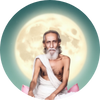
Bhagavan Ramana Maharshi
Ramana Maharshi was born Venkataraman Iyer on 30 December 1879 in the village Tiruchuzhi near Aruppukkottai, Virudhunagar District in Tamil Nadu, India. He was the second of four children in an orthodox Hindu Brahmin family. His father was Sundaram Iyer (1848–1890), from the lineage of Parashara, and his mother was Azhagammal (1864–1922). He had two brothers Nagaswami (1877–1900) and Nagasundaram (1886–1953), along with a younger sister Alamelu (1887–1953). His father was a court pleader.
Both a paternal uncle of his father and his father’s brother had become sannyasins. Venkataraman’s family belonged to the Smarta denomination, and regularly worshiped Shiva, Vishnu, Ganesha, Surya and Shakti in their home.
When Venkataraman was seven he had his upanayana, the traditional initiation of the three upper varnas into Brahmanical learning and the knowledge of Self. He had a very good memory, and was able to recall information after hearing it once, an ability he used to memorize Tamil poems.
Narasimha notes that Venkataraman used to sleep very deeply, not waking from loud sounds, nor even when his body was beaten by others. When he was about twelve years old, he may have experienced spontaneous deep meditative states. Sri Ramana Vijayam, the Tamil biography that first appeared in the 1920s, describes a period a few years before the death-experience in Madurai:
Some incomplete practice from a past birth was clinging to me. I would be putting attention solely within, forgetting the body. Sometimes I would be sitting in one place, but when I regained normal consciousness and got up, I would notice that I was lying down in a different narrow space [to the one where I had first sat down].
When he was about eleven his father sent him to live with his paternal uncle Subbaiyar in Dindigul as he wanted his sons to be educated in the English language, so that they would be eligible to enter government service. Only Tamil was taught at the village school in Tiruchuzhi, which he attended for three years. In 1891, when his uncle was transferred to Madurai, Venkataraman and his elder brother Nagaswami moved with him. In Dindigul, Venkataraman attended a Hindu School where English was taught, and stayed there for a year.
His father, Sundaram Iyer, died suddenly on 18 February 1892. After his father’s death, the family split up; Venkataraman and Nagaswami stayed with Subbaiyar in Madurai.
In November 1948, a tiny cancerous lump was found on Ramana Maharshi’s arm and was removed in February 1949 by the ashram’s doctor. Soon, another growth appeared, and an eminent surgeon performed another operation in March 1949 with radium applied. The doctor told Ramana Maharshi that a complete amputation of the arm to the shoulder was required to save his life, but he refused. Third and fourth operations were performed in August and December 1949, but only weakened him. Other systems of medicine were then tried; all proved fruitless and were stopped by the end of March when devotees gave up all hope. To devotees who begged him to cure himself for the sake of his followers, Ramana Maharshi is said to have replied, “Why are you so attached to this body? Let it go”, and “Where can I go? I am here.”[11] By April 1950, Ramana Maharshi was too weak to go to the hall and visiting hours were limited. Visitors would file past the small room where he spent his last days to get one final glimpse. He died on 14 April 1950 at 8:47 p.m.[web 9] At the same time a shooting star was seen, which impressed some of his devotees as a synchronicity.